Why did Riemann propose the Riemann zeta function?
Riemann was, first and foremost, a geometer. His deep research into the structure and geometry of manifolds set the stage for the field known today as Riemannian Geometry, which is fundamental for many domains of math and physics.
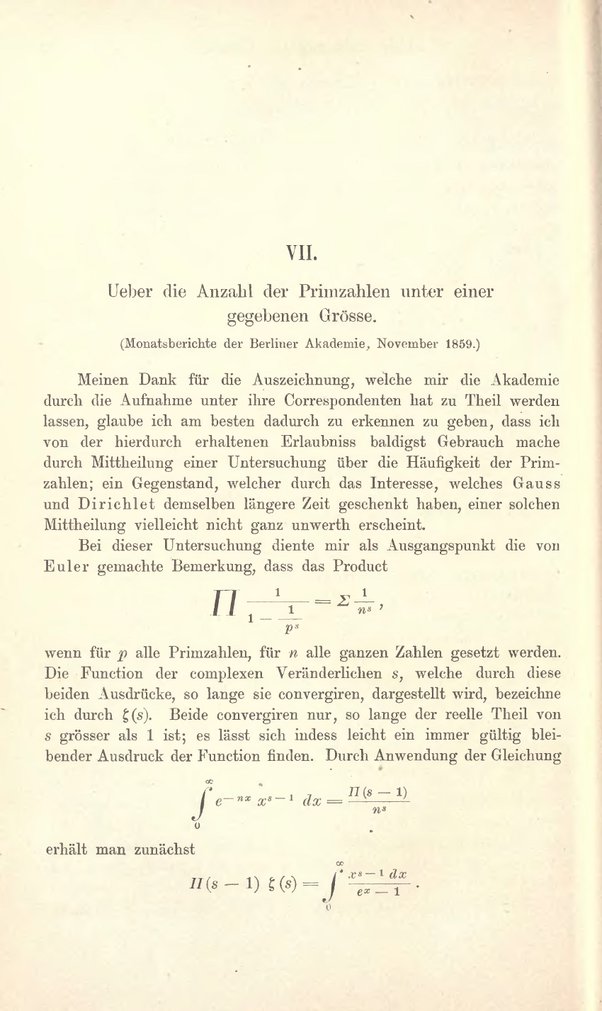
Riemann wrote a single paper on number theory. One. That paper, the 1859 "On the number of primes less than a given magnitude", was ten (10) pages long, and it spawned a whole new field that is being intensely researched to this day. He wrote it at the suggestion of Gauss, who somehow felt that the young prodigy could do something meaningful in that domain.
Riemann's unbelievably deep insight was that he can take a fairly simple-looking function defined by Euler, apply the very new idea of analytic continuation to extend that function into areas where it didn't previously exist, perform Fourier inversion on the result, and obtain a profound new formula for the number of primes less than a given value.
That was his main goal: to study the frequency at which prime numbers show up. The hypothesis known today as the Prime Number Theorem, which says that there are about x/\log(x) primes up to x, was already in the air - Gauss guessed it and others (mostly Chebyshev) had started making progress towards it. Riemann had a brilliant idea for attacking such questions using the tools of complex function theory and Fourier methods, and this idea centered on the function that today bears his name.
The basic connection between the function \sum_{n=1}^\infty \frac{1}{n^s} and prime numbers was already observed by Euler, decades earlier. But pushing this fairly simple observation into a profound theory required Riemann's ingenious plan.
Every step of this plan was new and technically demanding. The whole program was shockingly original, and this was likely one of the single most important breakthroughs in the history of mathematics.
Ten pages. You can read the whole thing (in English+math) here.